
Rubber: structuring and financing the value chain in CEMAC
HIG’s strategic note examines the global natural rubber market and opportunities to finance processing, traceability and producers in Cameroon and Gabon.
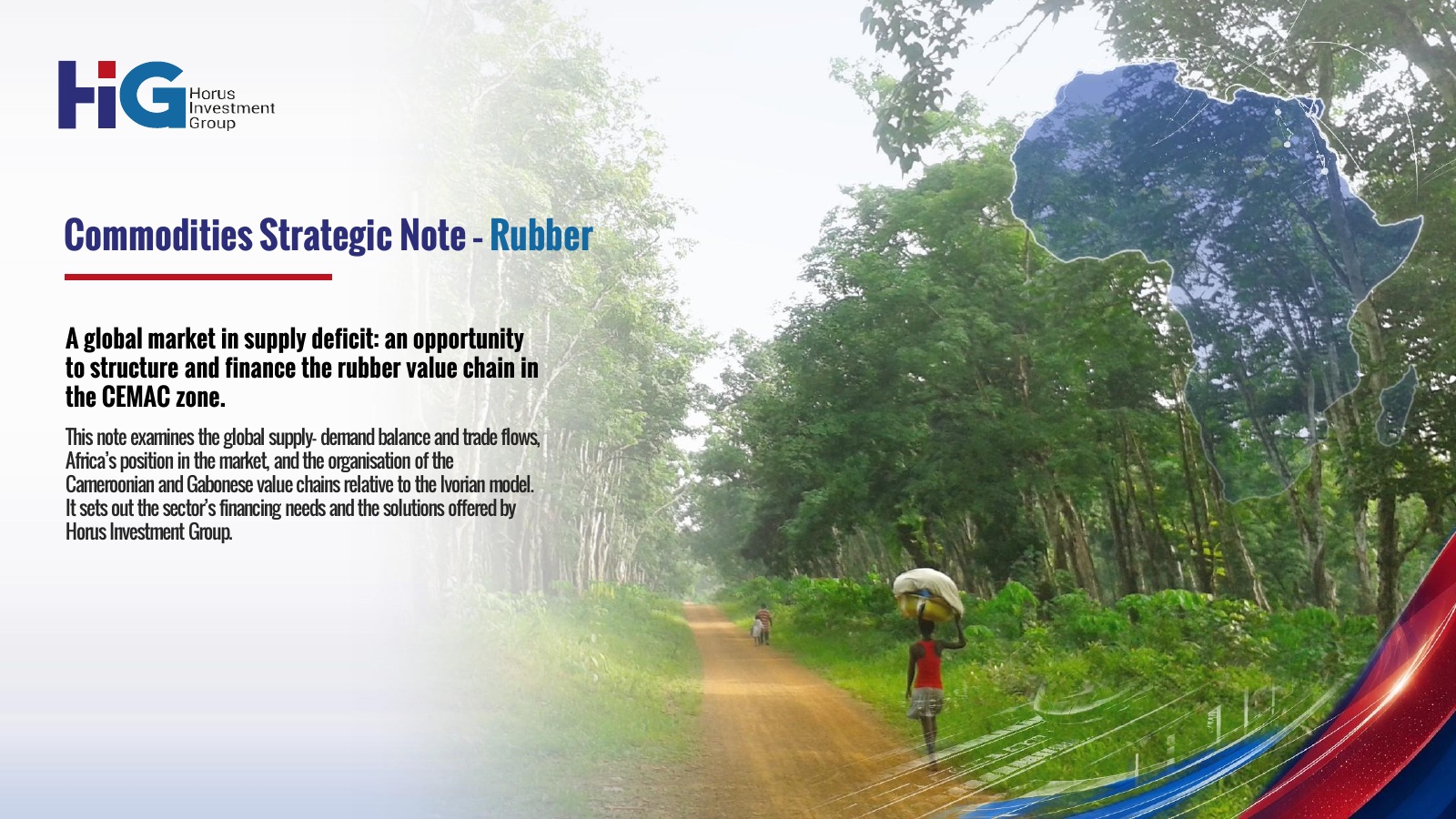
How can Central Africa capture more value from natural rubber? In its Commodities Strategic Note – Rubber, Horus Investment Group examines the global market, the organisation of production in Cameroon and Gabon, and the financing needed to develop the value chain.
A global supply deficit, with a narrower gap expected
The HIG note reports global natural rubber production of 14.9 million tonnes in 2025 against consumption of 15.34 million tonnes, citing ANRPC data. This represents a supply deficit of 440,000 tonnes.
The outlook requires some nuance. According to the ANRPC forecast reproduced in the note, the deficit could narrow to 100,000 tonnes in 2026. HIG therefore highlights the importance of managing price risk when structuring production campaign financing.
Cameroon and Gabon: competing on value
Côte d’Ivoire provides the African benchmark. The note puts its 2025 production at 1.9 million tonnes and exports at USD 3.25 billion, making it the world’s second-largest exporter.
For Cameroon and Gabon, the publication cites BEAC forecasts of approximately 63,100 tonnes combined in 2025, equivalent to around 0.4% of global production. These figures are forecasts, rather than confirmed production results.
Given this smaller scale, HIG’s analysis favours differentiation through higher-value products and local processing. It identifies medical-grade latex in Cameroon as an example of this approach.
Organisation is part of the financing equation
The publication compares Côte d’Ivoire’s sector framework, including the APROMAC interprofessional organisation, the CHPC regulator and the FIRCA sector fund, with the structures in Cameroon and Gabon.
In HIG’s assessment, the absence of equivalent coordination mechanisms limits collective bargaining and access to finance. Organising the value chain is therefore part of making projects financeable, alongside their technical and commercial preparation.
Matching financial solutions to the value chain
The note identifies opportunities in local processing, collection and export campaign pre-financing, traceability and smallholder credit. It also considers structured finance, blended finance and public-private partnerships as possible ways to address these needs.
HIG’s approach combines project preparation, financial structuring, fundraising and transaction support to connect African investment opportunities with international capital.
Read the full strategic note in our library.